Do you have an aloe plant? Here are some tips on how to care for it.
Plants of the Aloe genus have always been classified in the Liliaceae family, because they are related, like lilies, onions, garlic and asparagus, to an original bulb.
This was considered correct until recently, when Tom Reynolds, a London researcher, drew up a new classification. Given its specific and particular characteristics, he placed Aloe in a new botanical family, Aloaceae.
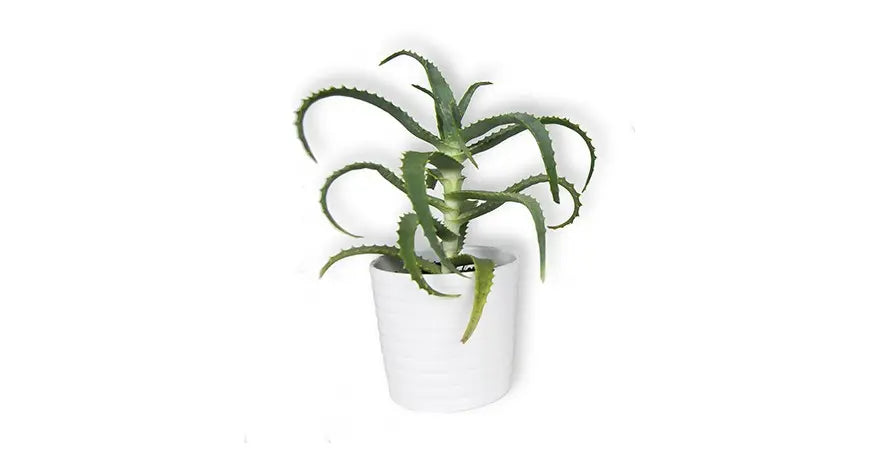
The Aloe Arborescens plant is the one that adapts best to our temperatures because its narrow, threadlike leaves have a thicker outer cuticle, which makes the plant resistant to climatic and environmental harshness.
This species blooms between December and February and the flowers range from orange to bright red.
Aloe does not particularly like the cold, the ideal temperatures for good growth of the plant vary between 19-25°C.
Its main enemies are low temperatures and humidity.
If you live in areas where winter temperatures are not particularly harsh (southern or coastal areas), you can plant it directly in your garden. Otherwise, it needs to be protected during the winter, so I recommend growing it in a suitably sized pot so you can bring it indoors during the coldest months.
It's best to grow Aloe in well-drained soil, where water can drain without stagnating. If you're growing it in a pot, don't use a saucer, otherwise water could stagnate and the Aloe plant could rot.
Watering, how to do it:

During the hottest summer months, Aloe Arborescens should be watered once or twice a week, taking care not to wet the leaves. Avoid allowing water to collect between leaves, otherwise you risk rotting them.
With the arrival of autumn, watering your Aloe should gradually decrease, until it's completely stopped for the entire winter. In spring, watering should gradually resume. Remember that Aloe tolerates drought very well and waterlogging much less well.
How to repot an aloe plant


You need to do this every year in spring, gradually increasing the size of the pot.
Aloe does not have deep roots, it is better to use a wider than deep pot with drainage holes since, as already mentioned, Aloe absolutely does not like water stagnation.
Aloe does not need to be pruned ; it is sufficient to clean the base of all the leaves that dry out over time.
Fertilization
Aloe Arborescens doesn't require fertilization . If you really want to, it should be done once a month, starting in spring and continuing through the end of summer.
Since you will probably be using the leaves for the recipe for the Aloe Arborescens preparation by Father Romano Zago , DO NOT use chemical fertilizers . Make sure to make natural, DIY preparations. For example, nettle macerate provides nutrients such as nitrogen, potassium, and phosphorus without damaging the soil with chemicals.
What is the health indicator of the Aloe plant?

The leaves indicate the state of health of the plant:
- If the leaves start to turn yellow, have yellow and brown spots and curl up, pay close attention because the plant is probably under attack from the Red spider mite, a mite that causes a lot of damage. How do you spot it? If you look closely at the leaves, you'll notice very fine webs on the undersides. To eliminate the problem, try using a natural homemade garlic-based insecticide. Alternatively, you can use neem oil.
- If you notice cotton-like tufts at the base of the leaves, your plant may be infested with cochineal. To eliminate them, use a cotton swab soaked in denatured alcohol and place the tip directly on the cochineal; the insect will dissolve completely.
- If the leaves lose their characteristic spotted color it means that the lighting is poor, in this case it is enough to simply move the plant to a brighter place.
If you want to discover all our products based on organic Aloe Arborescens from Italian crops, CLICK HERE