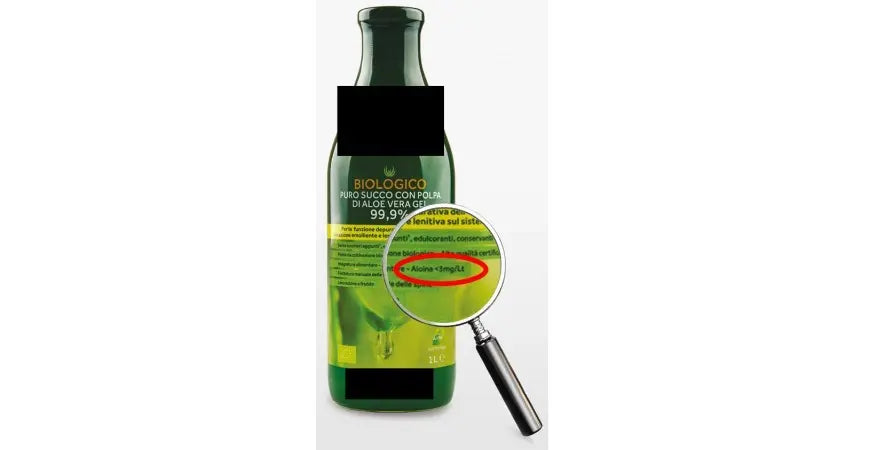
Is aloin toxic? Is it harmful? This is currently the most debated topic in the aloe world .
In this article, I'll reveal the whole truth about the properties of aloin, its toxicity, and the current fads that impose reckless product variations for purely commercial and marketing purposes.
The question most people ask is: Is aloin toxic? Is it harmful?
Let's start with a simple explanation.
Aloin is one of the molecules that belong to the anthraquinone group. Anthraquinones are clearly recognized for their intestinal regulatory action, including a laxative effect. The main molecules that belong to the anthraquinone group are:
- Aloin;
- Aloetic Acid;
- Anthranol;
- Chrysophanic Acid;
- Resisthanol;
Many of these components are known and used by pharmaceutical companies to prepare laxative and digestive products.
In particularly sensitive individuals, diarrhea may occur at high doses and in the initial stages of Aloe use; however, within a few days of continuing treatment, this symptom tends to subside and eventually disappear. For this reason, many manufacturers of Aloe vera preparations for food use prefer to use only the Aloe gel and not the entire leaf, subsequently using "purifying" methods such as activated carbon filters or other even more destructive processes.
And this is where the fun begins.
This and other procedures also remove components with extraordinary phytotherapeutic properties from the preparation, losing its important detoxifying, antibacterial, antiviral, antioxidant, and antitumor properties.
Leaving this extremely high therapeutic potential untapped is like committing a crime.
Properties of anthraquinone components:
- Aloetic acid: It has a natural antibiotic action, especially in combination with the other anthraquinones present in aloe.
- Cinnamic Acid : with intense antibiotic, antibacterial, germicidal activity, effective against various bacteria such as salmonella, streptococci and staphylococci.
- Chrysophanic Acid: It is a good purifying, diuretic, laxative agent, with eupeptic and tonic properties.
- Aloemodin: It boasts important cytotoxic effects especially against precancerous and cancerous cells of particular tumors, as numerous experimental observations in vitro and in vivo have demonstrated.
- Aloin: It occurs in the form of two isomers known as Aloin A and B and is the fictional name of the molecule that most represents the anthraquinone class. It has laxative, detoxifying, antibiotic, and antitumor properties.
Why do 95% of companies use only the gel and not the whole leaf, even though it is a treasure trove of beneficial properties?
We have summarized the reason in the following table:
| ALOE WORKED ONLY WITH GEL | ALOE CLAVORATA WHOLE LEAF | |
| Color | Transparent | Yellowish |
| Odor | Odorless | Pungent odor |
| Taste | Tasteless | Bitter |
Is it clearer now? It's a commercial issue.
Products made with the whole leaf have a yellowish color, a pungent odor, and a bitter taste. From a commercial standpoint, these characteristics are "unwelcome" to consumers! Having a product that is visually transparent and pleasant to the taste allows companies to advertise a "differentiating" idea. In doing so, they delude you into thinking they're providing added value, but in reality, they're offering you a weakened, substandard product.
Unfortunately, the world of Aloe is taking a bad turn. The general modern trend is to offer products that are beautiful to look at (transparent, crystalline in color) and tasty to consume (with strawberry, lemon, blueberry flavors and so on), without caring about the effectiveness that the product itself should have.
The primary objective is relegated to the back burner. Don't forget that if you take aloe, it's because you expect therapeutic efficacy from the product, even at the expense of taste, smell, and color. What you should care about is the end result.

Taking a preparation made with the whole leaf allows you to benefit from the entire arsenal of elements present inside Aloe and not just from the internal gel .
It is no coincidence that in the original recipe for the Aloe preparation, of which Father Romano Zago is the main world disseminator, Aloe Arborescens is used instead of Aloe Vera.
Is the gel or the whole leaf used in Aloe Arborescens preparations?
Unfortunately yes!
Recently, even some manufacturers of Aloe Arborescens preparations have been infected by the trend of using only the gel.
Although it must be said that the phenomenon is much less widespread with respect to Aloe Vera producers, since Aloe Arborescens is used mainly for therapeutic purposes and in these cases little attention is paid to the color, flavor and smell, but rather to the effectiveness, which is unquestionably greater if the whole leaf is used.
History of the limits of aloin use.
In 2013, the EFSA (European Food Safety Authority) concluded that hydroxyanthracene derivatives (in the case of aloe they refer to aloin A+B) in foods can improve intestinal function, but recommended avoiding long-term use and consumption at high doses , due to potential safety concerns.
The European Commission is therefore asking EFSA to establish a safe daily limit for the intake of these substances.
In 2014, to determine whether there were any limits to the daily intake of aloin, we personally wrote to the Italian Ministry of Health, Department of Food Safety.
To ensure this, we personally wrote to the Ministry of Health, Department of Food Safety.

and here is their response:

In 2018, the EFSA made a dramatic U-turn, expressing a negative opinion, stating that it was unable to establish a safe daily limit and that anthraquinones (derivatives of hydroxyanthracene) could be harmful to the body. The negative opinion cited studies with aloe administered to rats at doses 200 times higher than those recommended for humans. Again, this was administered at daily doses 200 times higher than those recommended for humans.
But that's not all. Some studies cited in the EFSA's negative opinion even refer to DANTRON, a synthetic substance that has nothing to do with actual daily aloe intake. From a scientific standpoint, this makes no sense; it's like mixing apples and oranges.
Based on the EFSA statement, the European Commission decides to introduce a limit of 1 ppm of anthracene derivatives per daily dose.
This means that aloe-based preparations (gel or leaf) must not contain more than 1ppm of Aloin A+B in the daily doses indicated by the manufacturers.
Products that do not meet this parameter cannot be sold.
This is a rather superficial and reckless decision because dozens and dozens of studies demonstrating the safety of hydroxyanthracene derivatives were not taken into consideration.
Of course, these molecules can be present in drugs instead.
Furthermore, measurable concentrations of hydroxyanthracenes have been found in common vegetables that we consume daily, for example:
beans (levels up to 36 ppm)
lettuce (levels up to 5.9 ppm)
peas (levels up to 3.6 ppm).
As you can see, we are at levels significantly higher than the daily limit of 1 ppm established for aloe.
According to this provision, hydroxyanthracene derivatives, if contained in aloe, can be harmful; if contained in other foods or drugs, they do not create problems.
It's well known that an overdose of aloin can cause diarrhea, but it's also well known that overuse and excessive use of anything is harmful and damaging to our health. Even water can be harmful if consumed in excessive quantities!
To confirm what has been said so far, we bring you a short excerpt from the treatise entitled "Phytopharmacy: Rational Use of Herbal Drugs" written by Prof. Francesco Capasso, Prof. Giuliano Grandolini, Prof. Angelo A. Izzo, three of the leading experts in phytotherapy in Italy.
Premise:
In pharmacology, the term "herbal drug " refers to a plant or part of a plant, preserved in a dry state and used for therapeutic purposes. So, in our case, Aloe is a herbal drug.
I. Excerpt from the chapter The Complexity of Natural Medicine:
The goodness of a herbal drug is directly related to its content of active ingredients.
However, the drug contains numerous other substances that give it a particular therapeutic profile that is difficult to reproduce in the laboratory. These are inactive substances or those of minimal pharmacological interest, such as bitter or aromatic compounds that, by enhancing gastrointestinal secretions, facilitate the dissolution and absorption of the active ingredients.
Translating this to our case, it means that aloe contains numerous substances that, while inactive or of minimal pharmacological interest, are essential. In particular, aloin (a bitter substance), in addition to the properties we've extensively analyzed previously, has a fundamental effect: it enhances gastrointestinal secretions to promote the absorption of other active ingredients.
II. Excerpt from the chapter The Complexity of Natural Medicine:
In many cases, it has been found that the "pool" of pharmacologically active substances present in the drug is more effective than the active ingredient of a drug, as synergies are established between it and the other components that are useful for achieving the medicinal effects and/or antagonisms for the side effects, whether they are harmful (toxic) or simply unwanted:
Returning to our case, more important than the individual active ingredient is the combination of the pharmacologically active substances present in Aloe, as they can interact beneficially with each other. Indeed, some substances, which taken individually can be toxic, become useful and medicinal when combined with others. This is one of the most fascinating characteristics of phytotherapy.
III. Text of the treaty:
In most cases, herbal drugs represent a synergistic complex of active ingredients that perform specific actions and applications that are difficult to replace or reproduce. It's obvious that any attempt to purify the crude extract will alter the behavior of the finished product.
More clearly, Aloe possesses a set of active ingredients that interact with each other and have specific actions and applications that are difficult to replace or reproduce. It is obvious that any attempt to purify the raw extract, such as sterilizing or pasteurizing Aloe, it does nothing but weaken the effects of the finished product.
Professor Luigi Lucini, a lecturer at the Catholic University of the Sacred Heart, in one of his chemical-biological studies on Aloe Arborescens and Aloe Vera (barbadensis) plants, also states that:
The leaves of Aloe Barbadensis and Aloe Arborescens contain numerous beneficial molecules for humans and animals including:
1. Numerous antioxidants concentrated in the leaf dermis (cuticle)
2. Polysaccharides concentrated in the leaf gel
The most important antioxidants present in Aloe plants are above all Aloin, but also other unknown molecules (alosone, aloesin, aloeresin, and aloenin) having effects:
- ANTIOXIDANTS: They prevent the formation of free radicals, slow down aging, and counteract the development of degenerative diseases and mutations in general.
- ANTIMICROBIALS AND ANTIVIRALS: they counteract the growth of microorganisms that are pathogenic for humans and animals
- PURIFYING
Antioxidants are concentrated in the leaf dermis (cuticle) and are very abundant in the Aloe Arborescens species.

Total Aloe leaf homogenates have anti-radical properties intermediate to those provided by the gel and leaf dermis alone.
As you may have noticed, Professor Lucini also refers to preparations made with the entire leaf and not "purified." Furthermore, all the researchers involved in the study agreed that the numerous therapeutic and pharmacological effects of Aloe, which we listed previously, are due to a SYNERGISTIC action between the different biomolecules and nutritional components concentrated in the ENTIRE leaf.
We can therefore affirm that:
Aloe Arborescens, taken in the right doses, must be consumed whole to benefit from all its active ingredients. We can compare it to an orchestra that, with the harmony of all its elements, performs flawless symphonies. Removing the peel or using other processes such as sterilization, pasteurization, or filtration, only distorts and weakens the effects of Aloe. If one or more elements are removed from an orchestra, it is obvious that the harmony will no longer be the same.”
To date, the advice is still to safely take extracts made with the whole leaf. Aloe must be consumed in its entirety. If we remove components, we do nothing but weaken the final effect, disappointing consumer expectations.
Feel free to take extracts made from the whole leaf. Aloe must be consumed in its entirety. If we remove parts, we only weaken the final effect, disappointing consumers' expectations.
If you are looking for a product made with the best variety of Aloe, namely Aloe Arborescens, made with the whole leaf, so as not to weaken its therapeutic effects and at the same time respects the parameters indicated by the European Commission, you just have to do >>CLICK HERE<<