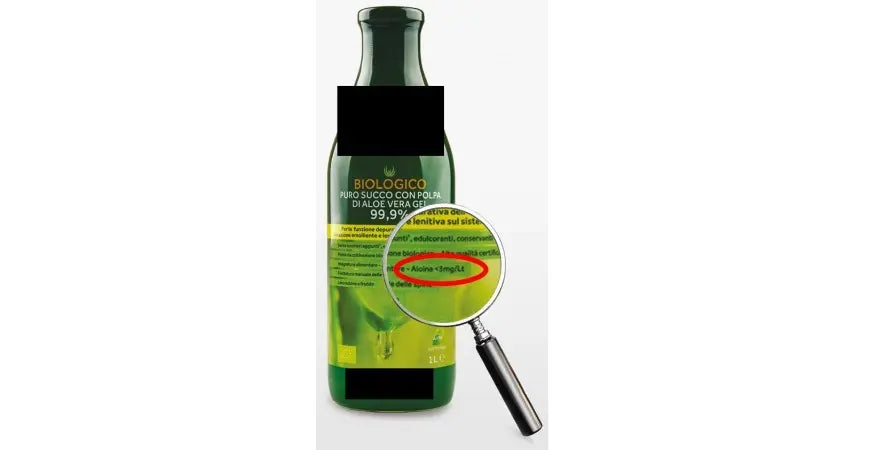
Have you been told to look for aloe without aloin?
Before you dive headfirst into your research, you absolutely must read this.
But let us ask you a question, or rather two.
1) Are there products that are 100% aloin-free?
2) Have you ever seen a product whose label says “aloin-free”?
We took the trouble to check it out ourselves, we traveled far and wide, we even went to the moon and after months of research we can give you an answer.
Guess?
It's simple.
The answer is NO
Why?
Simply because there are no products that are 100% aloin- free.
We want to be honest because we have actually found some products with the words "ALOIN FREE", but...
there's a but…
As you can see from some of the images below, there are some clever people who write “ALOIN FREE” in capital letters and immediately below in tiny, tiny letters, which you would need binoculars to read, writing less than a certain amount.

What does this mean?
That it is practically impossible to eliminate aloin 100%.
This leads to the logical consequence that in all the products you see for sale in pharmacies, herbalists, on the internet, in supermarkets, and from the door-to-door salesman on duty, ALOIN IS PRESENT, even if in a minimal percentage.
We realize this may be shocking news for you, since no one has ever bothered to tell you the truth , since aloin-free aloe is all the rage. Every day, some freak show wakes up and starts making up some pretty funny stories.
Even if you wanted to remove 100% of the aloin, which is practically impossible, you would have to use processes that destroy a huge percentage of the active ingredients, impoverishing the aloe so much that you risk drinking only fresh water.
What are these processing methods?
For example, sterilization or pasteurization, which bring aloe to very high temperatures.
Or filters are used to filter the Aloe to eliminate the aloin.
What happens in these cases? That we clumsily try to eliminate all the aloin, but at the same time we literally sweep away an enormous quantity of active ingredients with important detoxifying, antibacterial, anti-inflammatory, antiviral, anti-tumor and antioxidant properties[1]*.
So the end result is a complete disaster because even using these mutilating processing methods, the aloin is still present, and not only that, the aloe is depleted of an enormous quantity of beneficial substances.
Why is it virtually impossible to remove all the aloin from the aloe leaf?
Because aloin is not only found in the outer part of the leaf (the peel), but is also found in the internal gel, albeit in smaller quantities.
To summarize, removing only the peel of the aloe leaf does not eliminate ALL the aloin, and attempting to use processes that also remove aloin from the internal gel of the aloe leaf, such as filtration, pasteurization, and sterilization, is not only impossible but also leads to catastrophic results because it weakens the effects of the aloe.
At this point, the game isn't worth the candle because these procedures destroy a huge percentage of the active ingredients, thus risking selling a totally ineffective product.
You risk spending around €20-25 to drink a litre of thirst-quenching fresh water and not beneficial aloe juice.
Just think that some aloe juice manufacturers recommend 100 or even 200 ml of aloe juice per day.
Why has open war been declared on aloin?
Why is it so demonized?
For 2 main reasons!
The truth is that aloin and in general all the anthraquinones present in Aloe have 2 major defects:
- a very bitter taste;
- a very pungent smell.

These features are unwelcome to consumers and this is a huge problem for those companies whose sole objective is to sell and generate profit.
What can be done to overcome these two problems?
1) Only the inner gel of the Aloe leaf is used.
2) To improve the flavor, other ingredients such as sugar, sweeteners, flavorings, and low-quality fruit juices are added, ending up altering the organoleptic properties of the final product, to the detriment of its benefits.
Having clarified the issue of the presence of aloin in various aloe products, let's move on to tackle another thorny issue head on.
And of course, since no one bothered to tell you the truth in this case either, we will.
Let's start again.
Is it true that aloin is bad for you?
Is it true that it produces side effects?
Let's start by saying that aloin has surprising beneficial properties with effects:
- ANTIOXIDANTS*: prevent the formation of free radicals, slow down aging, counteract the development of degenerative diseases and mutations in general.
- NATURAL ANTIBIOTIC*
- PURIFYING*
We certainly didn't invent these beneficial effects, but they clearly emerge from several studies you can read below. Before moving on to these studies, it's important to clarify this.
What are the side effects of aloin?
Aloin can have a laxative effect. In fact, particularly sensitive individuals may experience diarrhea at high doses and during the initial stages of aloe use. However, within a few days of continuing treatment, this symptom tends to subside and eventually disappear.
To avoid episodes of diarrhea, it is advisable for those who start taking Aloe for the first 3-4 days to take lower doses than those recommended.
So, to those who tell us that aloin can produce side effects, we respond that it is clear, it is obvious, it is well known that the abuse and excessive use of anything is harmful and detrimental to health.
Even water can be harmful if consumed in stratospheric quantities!
Those who claim that aloe is irritating or toxic due to its aloin content are unaware that there is research that clearly explains how, at the daily dosages normally recommended, the “risks” are non-existent.
There are many studies, research and experiments that clearly demonstrate the beneficial effects of aloin and that the alliance (what super experts call a synergistic effect) between the active ingredients present throughout the leaf enhances the final effect of aloe.
Prof. Francesco Capasso, one of the greatest experts in Italy on phytotherapy, explains in his treatise on Phytopharmacy[1] how the active principles of plants work, and in one part of the treatise he seems to have tailor-made the aloin question.
In short, it states that: more important than the active ingredient taken individually is the combination of pharmacologically active substances present in a plant, as they can interact beneficially with each other. In fact, some substances, which taken individually can cause undesirable effects, become useful and medicinal when combined with others.
If we apply this to aloe vera, this means that this fabulous plant possesses a complex set of active ingredients that interact with each other and have specific actions and applications that are difficult to replace or reproduce. It's obvious that any attempt to purify the raw extract, such as removing aloin, sterilizing, or pasteurizing the aloe vera, only weakens the effects of the finished product.
A further study[2] on the toxicity of aloe, lasting one year, with a dosage of 100mg per kilo, did not reveal any physical problems of any kind.
Taking 100mg of Aloe extract for every kilo of body weight theoretically means that a person weighing 70kg who takes 7000mg (= 7 grams) of Aloe arborescens extract (powder) every day for a whole year, should not have any problems whatsoever.
And 7 grams of powder is equivalent to approximately 14 500mg capsules (which are the capsules normally used in these cases).
Have you ever seen a product labeled with the words, “Recommended dosage: 14 capsules per day”?
Still in relation to the safety of using Aloe, the study by Dr. Matsuda[3] on the safety of using Aloe arborescens recalls that up to now no toxicity has been recorded with the oral use of this plant, whether in the form of a supplement or in the form of food.
Additionally, a study[4] examined the benefits of aloin in certain fields of medical application.
This study concludes that aloin has the potential to be a natural molecule of great interest for the development of specific curative medicines*.
Aloin, as a single active ingredient, is already used by some pharmaceutical industries to prepare laxative and digestive drugs.
Finally, to avoid boring you, Prof. Luigi Lucini, Professor at the Catholic University of the Sacred Heart, in one of his chemical-biological studies on Aloe Arborescens and Aloe Vera plants[5] states that antioxidants are concentrated in the leaf dermis (the peel) and are very abundant in the Aloe Arborescens species.
Furthermore, all the researchers involved in the study agreed that the numerous therapeutic and pharmacological effects of Aloe, which we have previously listed, are due to a SYNERGISTIC action between the different biomolecules and nutritional components concentrated in the WHOLE leaf.
And we'll stop with the studies here otherwise you'd risk getting bored.
To summarize briefly, what is highlighted in these studies is that more important than the active ingredient taken individually is the alliance of the active ingredients present in Aloe, because they are able to interact with each other usefully.
In fact, some substances that, taken individually, can cause side effects, when combined with others, become useful and medicinal.
This is one of the most fascinating features of phytotherapy.
So, in general, the advice is to choose products that are made with the entire aloe leaf and not just the internal gel if you want to benefit from the power of aloe's beneficial effects.
Now, having established that it is impossible to find products without 100% aloin, and that aloin does have beneficial effects, let's move on to analyze another fundamental question.
Are there maximum daily intake limits for aloin?
Not currently in Italy.
Some countries, such as Belgium and France, set maximum daily limits.
Belgium provides a maximum daily intake of aloin of 14 mg.
France is slightly more restrictive, with a maximum daily limit of 10 mg.
Some certification bodies set a quality standard for their certification program of no more than 10 ppm (10mg/kg) of aloin A and B for aloe products intended for oral consumption.
Don't waste time looking for aloe brands without aloin; you can safely take aloe with aloin that doesn't exceed these established parameters to avoid any unwanted effects.
If you want more information on the toxicity of aloin, we recommend reading "Is aloin toxic? Is it harmful?"
But let's get to the point:
At this point, you may be wondering: Is there a processing method that keeps daily aloin levels under control and at the same time allows us to utilize all the leaf's active ingredients without weakening its final beneficial effects?
Yes, certainly.
We are talking about the “HDR® Method”, the innovative, effective and tested Aloe processing method, protected by industrial secrecy.
100% guaranteed.
Aloe processed with the HDR® method offers a series of incomparable advantages:
1st Advantage:
It is possible to keep all the active ingredients of the entire Aloe leaf unchanged.
2nd Advantage:
Processing aloe with the HDR® method avoids the problems that arise with other conservation methods such as:
- Sterilization (use of high temperatures) destroys a good percentage of active ingredients.
- Pasteurization (using medium temperatures) allows for very limited shelf life (a few days).
- The addition of natural preservatives alters the organoleptic and nutritional characteristics of the product.
- The use of mutilating production processes, that is, the Aloe extract is taken made only with the internal gel and not with the entire leaf including the cuticle (peel), thus destroying a good percentage of active ingredients.
3rd Advantage:
What problems does the Metodo HDR® processing method solve?
- You don't have to worry about the honey, sugars, or sweeteners found in various aloe juices.
- You are no longer obliged to take preservatives and additives present in various aloe juices.
- Do not take flavorings used to mask the bitter taste which in many cases worsen the flavor.
- You can enjoy the benefits of Aloe even when you're out and about all day.
- Take Aloe avoiding the alcoholic part present in various juices.
4th Advantage:
Take only 100% pure Aloe, guaranteeing the same effectiveness as fresh juice and a longer shelf life in a completely pure and natural way without resorting to preservatives and various additives.
5th Advantage:
The HDR® method guarantees that you get your daily dose of aloin in complete safety.
It allows you to get the maximum benefits while avoiding any side effects.
Aloe processed with the “HDR® Method” contains aloin approximately 3 times lower than the maximum daily values established by some countries.
How is Aloe processed using the HDR® method?
To ensure you benefit from the over 300 active ingredients present in the entire Aloe leaf and not just the internal gel, the processing is done cold and all the water is extracted from the Aloe leaf.
Yes, exactly, unlike those who use water to triple the aloe's yield and dilute the juice, this method eliminates it, allowing you to benefit only from the active ingredients and at the same time allows you to NOT use preservatives, sweeteners, excipients, flavorings and various additives.
It is based on exactly the opposite of the processing methods mentioned above.
The result is a super concentrate of active ingredients.
What type of product does Aloe processed with the HDR® method create?
The result you get is Aloe powder “the green powder, elixir of long life”.
But what, aloe powder? Yes, that's right, aloe powder.
That aloe juice is better than powder is a misconception held by many, due purely to a "psychological issue." This belief has become entrenched over time.
Let me explain better: many are convinced that Aloe in syrup form is better than the powdered form, but this is not the case based on what you have just read and is also confirmed by comparative analyses between the fresh product and the powdered one.
You can see the comparative analysis in the photo below

Tests confirm that powdered aloe maintains the same active ingredients as freshly prepared aloe vera, ensuring the same effectiveness but with a longer shelf life, without the use of preservatives and additives. Plus, you can be sure you're getting only 100% pure aloe vera.
NB with dehydration only the water is eliminated from the leaf and not the active ingredients
Next, the green powder, the elixir of long life, is placed in transparent vegetable cellulose capsules that allow you to visually see the contents of what you are taking and placed in white blisters that keep the Aloe protected from light and air.
Ready to unleash a whole arsenal of beneficial substances for your body
The capsules contain Aloe Arborescens, a different variety from the common Aloe vera.
Several studies have highlighted that Aloe Arborescens has a concentration of active ingredients three times higher than Aloe Vera and therefore is more effective if the aim is to have a therapeutic action of the product.
Aloe-beta capsules are a practical, quick and easy way to make a huge difference to your health and well-being.
DISCOVER THE CAPSULES UP CLOSE
BIBLIOGRAPHY:
1. I)Bruce WGG 1975. Medicinal properties in the Aloe. Excelsa 57-58.
II) Kodym, A., 1991. The main chemical components contained in fresh leaves and in a dry extract from three years old Aloe Arborescens Mill. grown in hothouses Pharmazie 46, 217-219
III) Yamamoto, M., Masui, T,. Sugiyama, K., Yokota., Nagakomi, K., Nazakawa, H., 1991. Antiinflammatory actives constituents of Aloe Arborescens Miller
2. “Phytotherapy – Rational Use of Herbal Drugs” by F. Capasso – Giuliano Grandolini – Angelo Izzo.
3. “ A Systemic Review on Aloe arborescens Pharmacological Profile: Biological Activities and Pilot Clinical Trials ” by Abdel-Naser B. Singab et al.